
Water Filter or Purifier? What Backpackers Actually Need
This post contains affiliate links. If you buy through them, we may earn a commission at no extra cost to you. As an Amazon Associate we earn from qualifying purchases.
The water treatment aisle splits into two camps: filters and purifiers. Purifiers sound safer, but they often weigh more. So which one do you actually need for a weekend in the backcountry?
The tips below are compiled from the Centers for Disease Control and Prevention (CDC), the National Park Service (NPS), REI, and the gear reviewers named throughout. We left out prices because they change. This is general advice, not medical or safety training. Water quality and rules vary by area, so check the land manager for the place you’re visiting, and always follow your product’s label.
1. Know what a filter stops (and what it doesn’t)
“The difference between a water filter and a water purifier is the size of the microorganism each combats,” says REI. Filters catch protozoa, such as Giardia and Cryptosporidium, plus bacteria. Treeline Review puts it simply: “Filters remove protozoan cysts and waterborne bacteria. Purifiers remove protozoan cysts, bacteria, AND viruses.”
Pore size is where that line gets drawn. The CDC says filters with an absolute pore size of 1 micron or smaller, or ones certified to NSF/ANSI Standard 53 or 58 for cyst reduction or removal, remove parasites but not viruses or all bacteria. Filters with an absolute pore size of 0.3 micron or smaller remove bacteria and parasites, but still not viruses. “Absolute” matters: a “nominal” rating is only an average, the CDC explains, so some larger pores can let bigger germs through.
Viruses are much smaller. The CDC Yellow Book, its guide for travel health professionals, says that virus removal optimally takes pores of 0.01 micron or smaller, and that “Portable microfilters do not reliably remove enteric viruses (e.g., norovirus).”
2. Know what makes a purifier a purifier
A purifier handles all three: protozoa, bacteria, and viruses. The Yellow Book says “Ultrafilters with pore size of 0.01 µm should be effective for removing viruses, bacteria, and parasites,” but notes they cost more and need more pressure to push water through.
Other methods count too. In the CDC’s effectiveness chart, boiling, UV light, and a filter plus a chlorine dioxide disinfectant all rate effective against viruses too.
Where does the bar come from? A 1987 U.S. Environmental Protection Agency (EPA) testing guide for “microbiological water purifiers” challenges a device to reduce bacteria by six logs, viruses by four logs, and cysts by three logs, according to a 2012 article in the trade magazine Water Conditioning & Purification. That works out to 99.9999 percent, 99.99 percent, and 99.9 percent.
One more limit: none of this fixes chemical pollution. The CDC says water contaminated with chemicals, toxins, or radioactive materials can’t be made safe by boiling or disinfecting. Grand Canyon National Park adds that filters don’t remove dissolved cyanotoxins from algae.
3. Decide whether a filter is enough for your trip
For most backpackers in the U.S. and Canada, the reviewers say yes. REI says protozoa and bacteria are the main concern in the U.S. and Canadian backcountry, so a filter is generally enough. Treeline says “It’s generally considered safe to only use a filter in North America where viruses are uncommon in the backcountry.” CleverHiker and SectionHiker agree. The CDC Yellow Book’s table lines up with them for “wilderness water with little human or animal activity,” where it lists any single step, including a microfilter, as enough.
Not every official source goes that far. The NPS Backcountry Health page says water from natural sources “must be purified by boiling or filtering and disinfecting,” because “Filtering does not remove viruses.” Grand Canyon says “Filtration alone is not sufficient.” And the CDC’s main page lists boiling first and filtering then disinfecting as the next best option. If the park you’re visiting asks for a second step, follow its rules.
You’d want a purifier, or a second step, in a few situations the sources name:
- Water near people or livestock. For “clear surface water near human and animal activity,” the Yellow Book lists all enteric pathogens, including Cryptosporidium, and suggests heat, UV, an ultrafilter, or a microfilter plus a chemical step.
- International travel. REI suggests a purifier in less-developed regions abroad, naming viruses such as hepatitis A, rotavirus, and norovirus.
- Sewage or heavy use. CleverHiker says human sewage or international travel “may call for true purification.”
4. Pick your filter style: squeeze, gravity, or pump
REI describes three common styles:
- Squeeze filters. Fill a small pouch and squeeze water through the filter. REI notes some double as gravity or straw filters.
- Gravity filters. Hang a bag of dirty water and let it drain through the filter. REI says they suit large groups but are slower, and you need somewhere to hang them.
- Pump filters. REI says you can draw from shallow seeps, but pumping takes effort, and pumps weigh more.
5. Or go chemical, UV, or boil
Chemical treatment. The CDC rates chlorine dioxide effective against Giardia, bacteria, and viruses, but only “somewhat effective” against Cryptosporidium. Chlorine and iodine fare worse: the CDC fact sheet rates both “not effective” against Crypto. The Yellow Book says Cryptosporidium is “poorly inactivated by chlorine- or iodine-based disinfection at practical concentrations.”
Plan on waiting. REI gives 30 minutes to 4 hours, and longer for icy water. The Yellow Book says chlorine dioxide tablets and drops “require prolonged contact time of several hours.” For Micropur tablets, CleverHiker says “Cryptosporidium requires a much longer waiting period, up to four hours according to the instructions.” For bleach, the NPS says to “Let water sit for at least 30 minutes before drinking.” Cloudy water needs a higher dose or a longer wait, per the Yellow Book. The CDC says to follow the label, “including the contact time for disinfectants.”
Iodine has extra limits. The CDC says to avoid iodine-treated water if you’re pregnant, have thyroid problems, or are sensitive to iodine, and that no one should drink it for more than a few weeks at a time.
UV pens. The CDC says portable UV units can kill parasites, bacteria, and viruses “in small amounts of clear water.” REI says a pen treats a bottle in about 60 seconds but needs batteries, and that silty water needs prefiltering.
Boiling. The CDC calls boiling the best way to kill germs: “bring clear water to a rolling boil for 1 minute.” Above 6,500 feet, the CDC, the NPS, and REI all say to boil for 3 minutes. The Yellow Book takes a different view. It says water still boils well above the temperature needed to kill germs at common travel elevations, and it simply advises a full minute. The 3-minute rule is the more cautious choice. If fuel is short, the Yellow Book says you can heat water to the first sign of simmering, then keep it covered for 30 minutes.
6. Combine methods when the water is sketchy
The CDC’s recommended combination is to filter first, then disinfect. The filter catches the parasites a disinfectant can miss, and the disinfectant handles the viruses a filter lets through. The Yellow Book says a microfilter plus a chemical step “can be done in either order.” The CDC says to filter before using UV, since cloudy water blocks the light.
7. Take care of your filter (and your water)
- Prefilter murky water. “Looks gross? Consider pre-filtering,” says Treeline, suggesting a bandana or coffee filter. REI says a prefilter keeps the flow rate up and extends filter life, and calls one “absolutely essential” before UV on water that isn’t clear.
- Don’t let it freeze. CleverHiker says hollow fibers “must be kept from freezing after they’ve been wetted,” and warns that the damage may not be visible. REI and Treeline suggest sleeping with the filter in your sleeping bag on cold nights.
- Backflush. Filters slow down over time, especially in silty water, Treeline says. SectionHiker notes that squeeze filters “must be back-flushed with a cleaning syringe regularly.”
- Carry a backup. CleverHiker carries “a small independent chemical backup,” and Treeline and REI suggest tablets or drops in case your filter breaks or freezes.
- Keep dirty and clean separate. REI says to keep dirty and clean containers clearly separate. “Beware cross-contamination!” Treeline adds, suggesting you label containers and rinse a clean bottle’s lip if it touched the source. Grand Canyon says to wash your hands first: “It does no good to treat your drinking water if you recontaminate it during collection.”
8. Three picks, three ways to treat water
Here are three picks independent reviewers recommend, one of each type: a squeeze filter, a pump purifier, and chemical drops. Each has a catch.
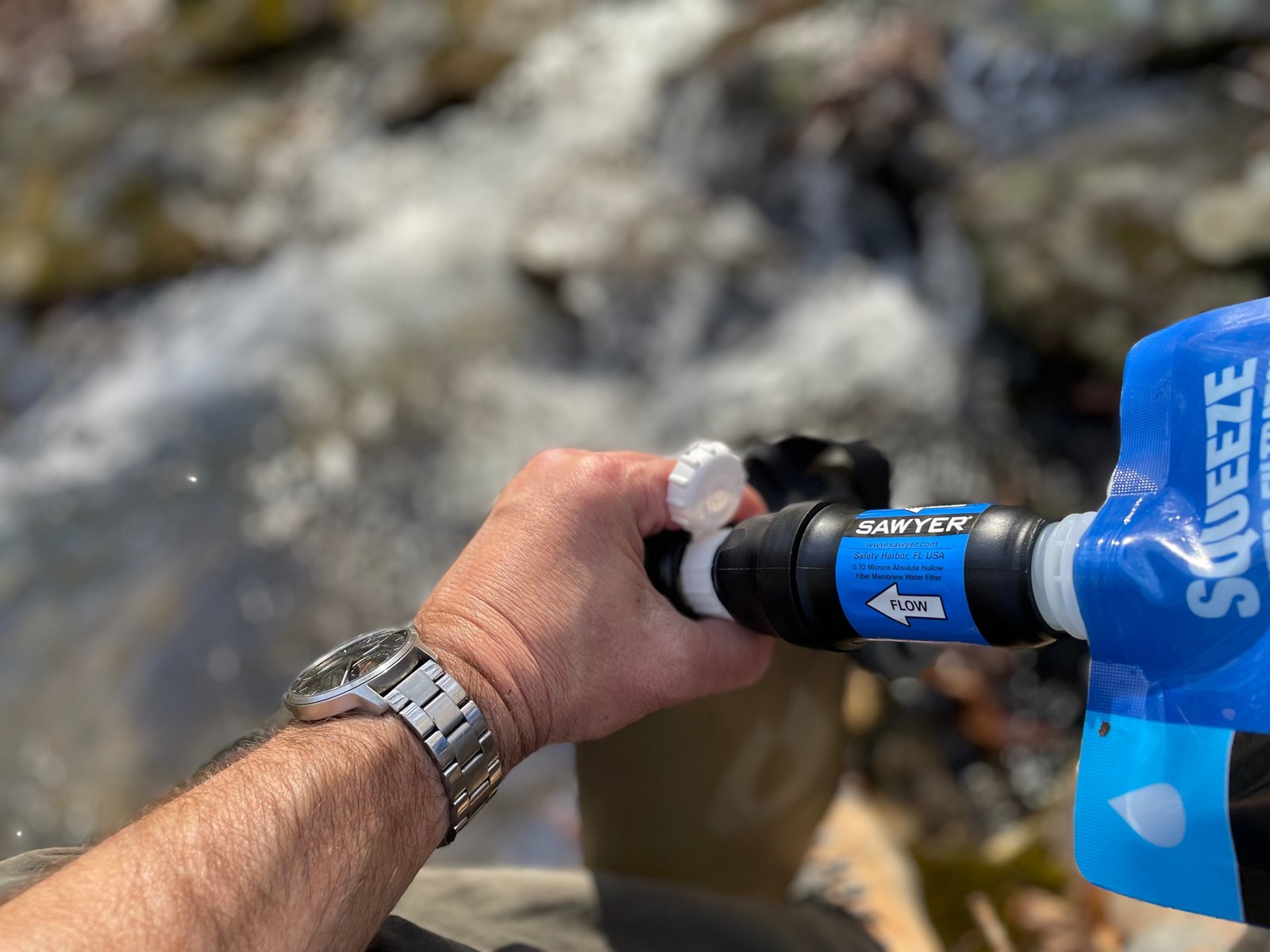
Sawyer Squeeze. CleverHiker names it its best backpacking water filter overall, calling it “Lightweight and compact.” It weighs 2.5 ounces (filter only) and has a 0.1-micron pore size, per CleverHiker’s specs. Treeline names it best for thru-hiking, citing “Cost, weight, speed, warranty.” The catch: it doesn’t remove viruses. CleverHiker says it “Needs regular syringe backflushing” and that its included pouches wear out. Treeline warns you “must keep it above freezing at all times” and that there’s “No way to test whether it is still working.”
MSR Guardian. Treeline names this pump its best water purifier, praising its “high quality and durability” and noting it “backflushes itself.” CleverHiker calls it the best filter “for Purifying the Worst of the Worst Water” and says its 0.02-micron membrane “addresses viruses as well as bacteria and protozoa.” The catch: it’s heavy, at 17.3 ounces by both CleverHiker’s and Treeline’s figures, and Treeline lists price as its main drawback. CleverHiker adds that it “does not replace dedicated treatment for dissolved industrial contaminants.”
Aquamira Water Treatment Drops. Treeline names these chlorine dioxide drops its best chemical treatment for “Ease of use, reliable.” CleverHiker makes them its budget buy and notes “Virus-capable purification.” They weigh about 3 ounces, by both reviewers’ figures. The catch: you have to mix two parts and wait. Treeline gives “five minutes for activation, then another 15-30 minutes” of treatment time. Cryptosporidium takes longer, since the CDC rates chlorine dioxide only “somewhat effective” against it, so check the label’s contact time.