
Trails / Hawaii / Hawaiʻi Island
Hawaiʻi Volcanoes Coastal Backcountry: Keauhou and Halapē
Hawaiʻi Volcanoes National Park (Kīlauea's south coast, Hawaiʻi Island)
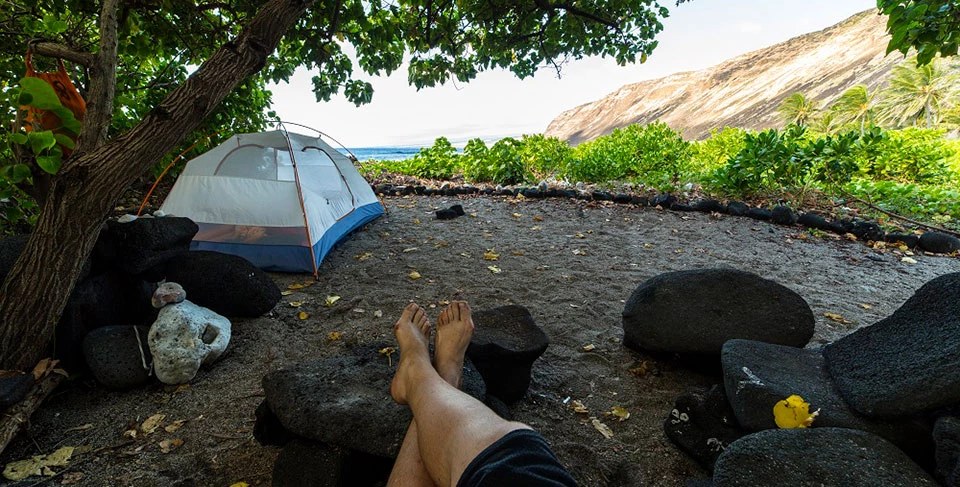
On the south coast of Hawaiʻi Volcanoes National Park, the Keauhou Trail drops from Chain of Craters Road across lava flows and grassland to two coastal campsites, Keauhou and Halapē, each with three-walled shelters and rain-catchment tanks. The National Park Service describes Halapē’s sandy beaches, cool water, and coconut trees, and Keauhou’s small rocky bay, where cold fresh water seeps up and mixes with the ocean.
It’s a hot, shadeless hike, and drinking water depends on the rain.
The hike
The Keauhou Trail starts at the Mau Loa o Maunaulu trailhead on Chain of Craters Road. NPS puts Keauhou 7.6 miles away and Halapē 8.5 to 9.2 miles, depending on route, with up to 3,000 feet of elevation change between trailhead and camp.
In a 2005 hike journal posted on the park’s website, Drew Erickson describes starting at about 2,680 feet and following ahu, the stone cairns, across dark pāhoehoe lava for a mile, then entering sparse ʻōhiʻa forest before reaching tall grass and lava flows that lead to the coconut grove by the beach at Halapē. NPS calls the Keauhou approach “grueling” and “hot,” through mostly non-native grasses.
The two camps sit close together. A 2006 scout journal on the park’s site says the group hiked from Halapē to Keauhou in 1.6 miles. NPS also lists longer approaches: Halapē is 8.0 miles from the Hilina Pali Overlook and 11.3 miles from Puʻuloa on the Puna Coast Trail, and Keauhou is 9.6 to 9.7 miles from Hilina Pali and 9.7 from Puʻuloa. The scouts came in on the Puna Coast Trail, descending three pali (cliffs), and described the first stretch as “very windy, dusty, and hot.”
Earthquakes are a real hazard on this coast. NPS, citing the 1975 earthquake and tsunami at Halapē, warns that if you feel a strong earthquake you should move to high ground immediately. The park’s general backcountry page adds seismic activity and flash flooding to the list of hazards.
Erickson says the Halapē shelter is “only a few hundred yards from the beach.” Nearby Halapē Iki has, in his words, “two small white sand beaches tucked into the lava flows, and a well protected swimming hole.” NPS says endangered hawksbill and threatened green sea turtles nest and rest on these beaches, and camping is restricted in posted nesting areas. NPS also notes sharks are occasionally seen, and that sea urchins and sharp rocks make wading hazardous.
At Keauhou, the scouts called it a “really nice campsite, which was next to these brackish water pools,” where they swam. NPS notes fishing restrictions from the park’s eastern boundary to a point midway between Keauhou and Halapē.
The climb out is the hard part. Erickson writes that leaving midday “was a mistake” because there was “no chance for shade,” and NPS advises against hiking the coastal trails between 10 a.m. and 2 p.m., when temperatures can reach the high 90s.
For a high, cold contrast, see Haleakalā’s crater on Maui.
Tips
- Hike early or late. NPS says to avoid the coastal trails from 10 a.m. to 2 p.m.
- Carry plenty of water. Catchment water isn’t guaranteed; ask rangers about levels and treat what you use.
- Know the earthquake rule. Move to high ground immediately after a strong quake.
- Watch the turtles. Stay out of posted nesting areas.
- Follow the ahu. Cairns mark the route across bare lava; Erickson found it hard to follow after dark.
- Bring a stove. Campfires and smoking are prohibited.
Camping
Backcountry permits are reserved on Recreation.gov up to 90 days ahead. NPS says you then check in at the Backcountry Office (open daily 8 a.m. to 4 p.m.) up to seven days before your trip to get the permit and a safety briefing. Stays are limited to three consecutive nights at one site and seven nights per permit. Halapē and Keauhou each take up to 16 hikers a night. Both have three-walled shelters with rain catchment tanks, but NPS says water “is NOT always available” and must be treated. Open fires and smoking are prohibited, and dogs other than service animals aren’t allowed on trails. Pack out all trash and use the composting toilets.
Inside Intel: Erickson recommends “if you have the time you should stay for two nights” at Halapē, and points to Halapē Iki’s protected swimming hole. The 2006 scouts liked Keauhou for its brackish pools, with one catch: “The only downside was that the water tank was half a mile away.” Erickson also advises filtering tank water: “it is not safe to drink directly from the tank.”
Trail facts
- Distance: 7.6 miles to Keauhou; 8.5 to 9.2 miles to Halapē (via the Keauhou Trail); about 17 to 18 miles round trip
- Route type: Out-and-back; the two camps are about 1.6 miles apart
- Difficulty: Strenuous; hot and exposed
- Elevation: Up to 3,000 feet between trailhead and camp
- Campsites: Keauhou and Halapē (16 hikers per night each; 3 consecutive nights max)
- Water: Rain catchment tanks at the shelters, not guaranteed; treat it and check with rangers
- Permits: NPS backcountry permit (Recreation.gov, up to 90 days ahead) plus in-person check-in
- Dogs: Not allowed (service animals excepted)
- Fires: Open fires and smoking prohibited
- Trailhead: Mau Loa o Maunaulu, Chain of Craters Road
- Last verified: October 6, 2026
Where this comes from
This page draws on the sources below, along with other guides and trip reports. Links go to the original pages.
- National Park Service: Backcountry Hiking
- National Park Service: Halapē
- National Park Service: Keauhou
- National Park Service: Nolo closure (Sept. 24, 2026)
- National Park Service: Post-Nolo reopening (Sept. 27, 2026)
- National Park Service: Most of park reopens (Aug. 28, 2026)
- NPS hike journal: Halapē, Drew Erickson (2005)
- NPS hike journal: Halapē, James Yamasaki (2006)
- Recreation.gov: Hawaiʻi Volcanoes Backcountry Permits
Before you go: This page is based on published trail guides, trip reports, and reviews, along with official park and agency information where we could find it. It’s meant to help backpackers discover new trails, not to replace current, official information. Conditions, closures, permits, campsites, and water sources change, and some details here may be out of date or wrong. Confirm everything with the managing agency and check current conditions before you head out, and don’t rely on this page alone for safety or navigation. Backcountry travel involves risk.