
Trails / Colorado / Sangre de Cristo Mountains
Great Sand Dunes Backcountry (Camping on the Dunes)
Great Sand Dunes National Park and Preserve, National Park Service (San Luis Valley)
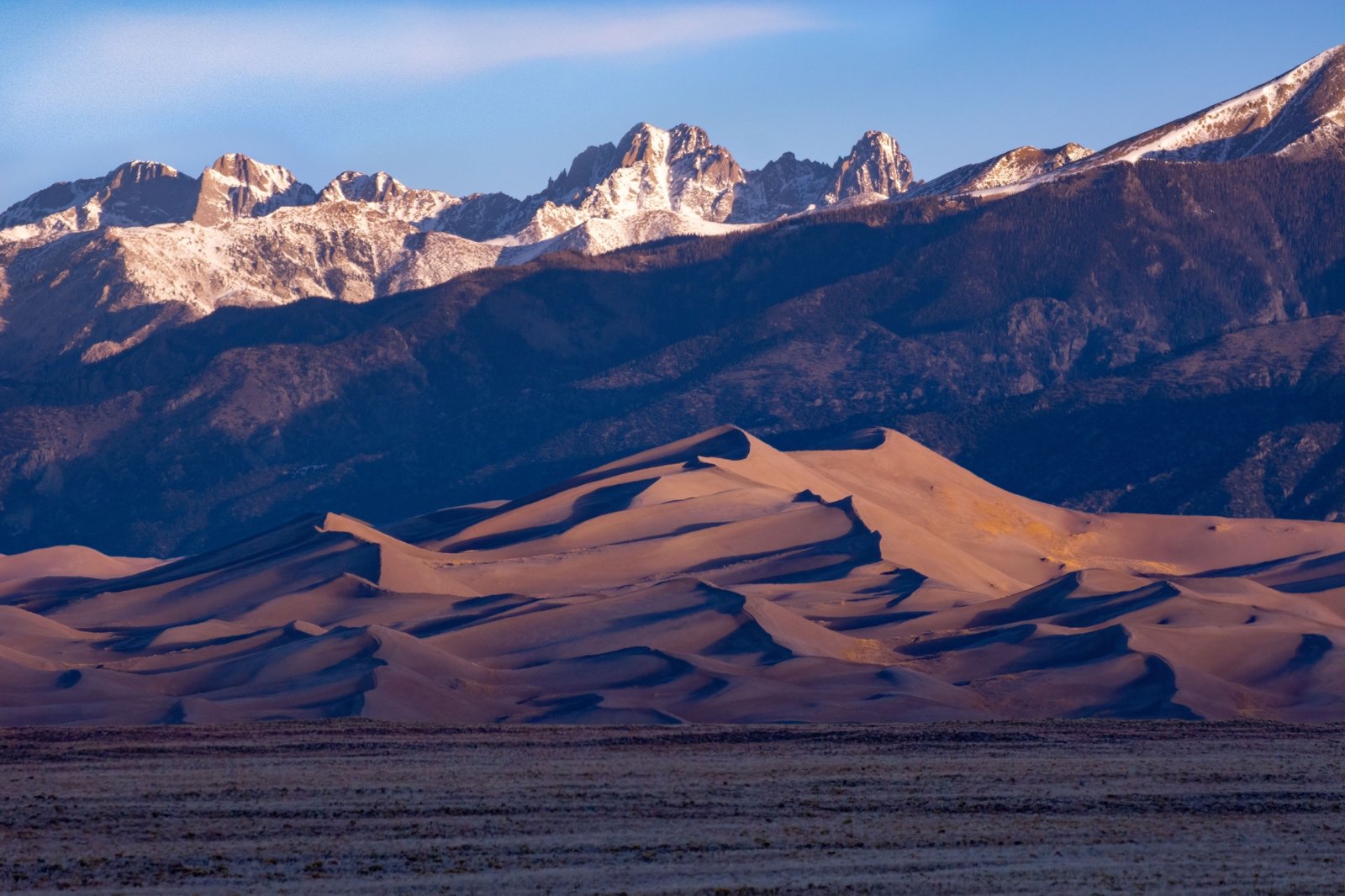
Great Sand Dunes National Park holds the tallest dunes in North America, rising below the Sangre de Cristo Mountains in Colorado’s San Luis Valley. The NPS says camping within those dunes is the more popular of the park’s two backpacking options. You hike at least 1.5 miles across open sand, beyond the day-use area, and pitch a tent wherever you like among the dunes.
There’s no trail, no water, and no shade, and lightning is a real danger.
The hike
The NPS defines the Dunes Backcountry as west of the high ridge and beyond the day-use area, at least 1.5 miles west of the Medano Creek bed. It says the park offers 20 non-designated sites there, plus seven designated sites along the Sand Ramp Trail. Ramble describes the dune field as 30 square miles.
The permit decides your parking. Recreation.gov says your assigned parking lot will be on your printed permit, and that you can request another parking area seven or more days ahead. The NPS backpacking brochure lists the Dunes Parking Lot as the starting point for the Dunes Backcountry, about 1.5 miles away. The NPS asks backpackers to print both their backpacking permit and parking permit.
From the parking area, you head west past the Medano Creek bed into the dunes. There’s no trail; you navigate across the sand to a campsite beyond the day-use area.
The Sand Ramp Trail is the other option. Recreation.gov describes its designated sites as a getaway through a variety of landscapes, with views of the dunes and mixed conifer forests at the base of the Sangre de Cristo Mountains. Campflare lists the seven sites: Buck Creek, Escape Dunes, Indian Grove, Little Medano, Aspen, Cold Creek, and Sand Creek. The NPS says you must camp within 50 feet of the metal arrowhead post at each one. It also notes some backpackers prefer the forested sites, such as Indian Grove.
Water is the biggest planning issue. The NPS brochure lists seasonal and reliable sources only for the Sand Ramp sites, and none in the dune field. Campflare suggests at least a gallon per person per night. Outdoorsy notes that some Sand Ramp sites are more than a mile from any water.
The NPS brochure gives water details for the Sand Ramp sites. Little Medano has seasonal water 0.3 mile away and reliable water in Medano Creek 0.5 mile away. Cold Creek has seasonal water about 300 feet away, with reliable water in Sand Creek 1.5 miles away. National Parks Traveler adds that the park also offers 21 first-come, first-served 4WD campsites along the Medano Pass Primitive Road.
The weather can be dangerous. The NPS and Recreation.gov both say that if lightning threatens, leave the dunes. Ramble advises camping only when the weather is calm. The NPS says bear hangs aren’t required in the Dunes Backcountry, and lists which areas allow pack animals overnight.
Outdoorsy calls the early fall months the best time for an overnight on the dunes. National Parks Traveler says Piñon Flats, the park’s only campground, is open April 1 to October 30, 2026, for those who want a night before or after.
For another sand-and-sky Western trip, see the Lost Coast Trail in California.
Tips
- Reserve your permit on Recreation.gov. The NPS says permits are reserved there.
- Carry all your water. There’s none in the dune field.
- Leave the dunes if lightning threatens. The NPS is clear on this.
- Print your permits. You’ll need both the backpacking and parking permits.
- Go in fall. Outdoorsy calls early fall the best season for a dunes overnight.
Camping
Camping in the Dunes Backcountry is non-designated, anywhere west of the high ridge and beyond the day-use area, at least 1.5 miles from the Medano Creek bed. The seven Sand Ramp Trail sites are designated, and you must camp within 50 feet of the arrowhead post. Permits are reserved on Recreation.gov. The NPS says bear hangs aren’t required in the Dunes Backcountry.
Inside Intel: The dunes themselves are the draw. The Dyrt’s camping guide rates the Backcountry Dunefield as the park’s highest-rated camping option, praising the solitude, the night sky, and the novelty of sleeping on sand. For shade and nearby water, the NPS points to forested Sand Ramp sites like Indian Grove.
Trail facts
- Distance: At least 1.5 miles one way to the Dunes Backcountry (about 3 round trip)
- Route type: Out and back, cross-country over sand
- Difficulty: Moderate; walking in sand is slow
- Campsites: 20 non-designated Dunes Backcountry sites; 7 designated Sand Ramp Trail sites
- Water: None in the dunes. Seasonal and reliable sources near some Sand Ramp sites. Carry what you need.
- Permits: Required; reserve on Recreation.gov
- Hazards: Lightning on exposed dunes; no shade
- Trailhead: Assigned on your permit (Dunes Parking Lot for the Dunes Backcountry)
- Last verified: October 2, 2026
Where this comes from
This page draws on the sources below, along with other guides and trip reports. Links go to the original pages.
- National Park Service: Great Sand Dunes Backpacking
- National Park Service: Backpacking brochure (PDF)
- Recreation.gov: Great Sand Dunes Backcountry Permits
- Campflare: Great Sand Dunes permits
- National Parks Traveler: Camping at Great Sand Dunes
- Ramble: 2026 Guide to Camping at Great Sand Dunes
- Outdoorsy: Great Sand Dunes guide
- The Dyrt: Great Sand Dunes camping guide
Before you go: This page is based on published trail guides, trip reports, and reviews, along with official park and agency information where we could find it. It’s meant to help backpackers discover new trails, not to replace current, official information. Conditions, closures, permits, campsites, and water sources change, and some details here may be out of date or wrong. Confirm everything with the managing agency and check current conditions before you head out, and don’t rely on this page alone for safety or navigation. Backcountry travel involves risk.