
Trails / California / Sierra Nevada
Thousand Island Lake via the River Trail
Ansel Adams Wilderness, Inyo National Forest (Agnew Meadows, near Mammoth Lakes)
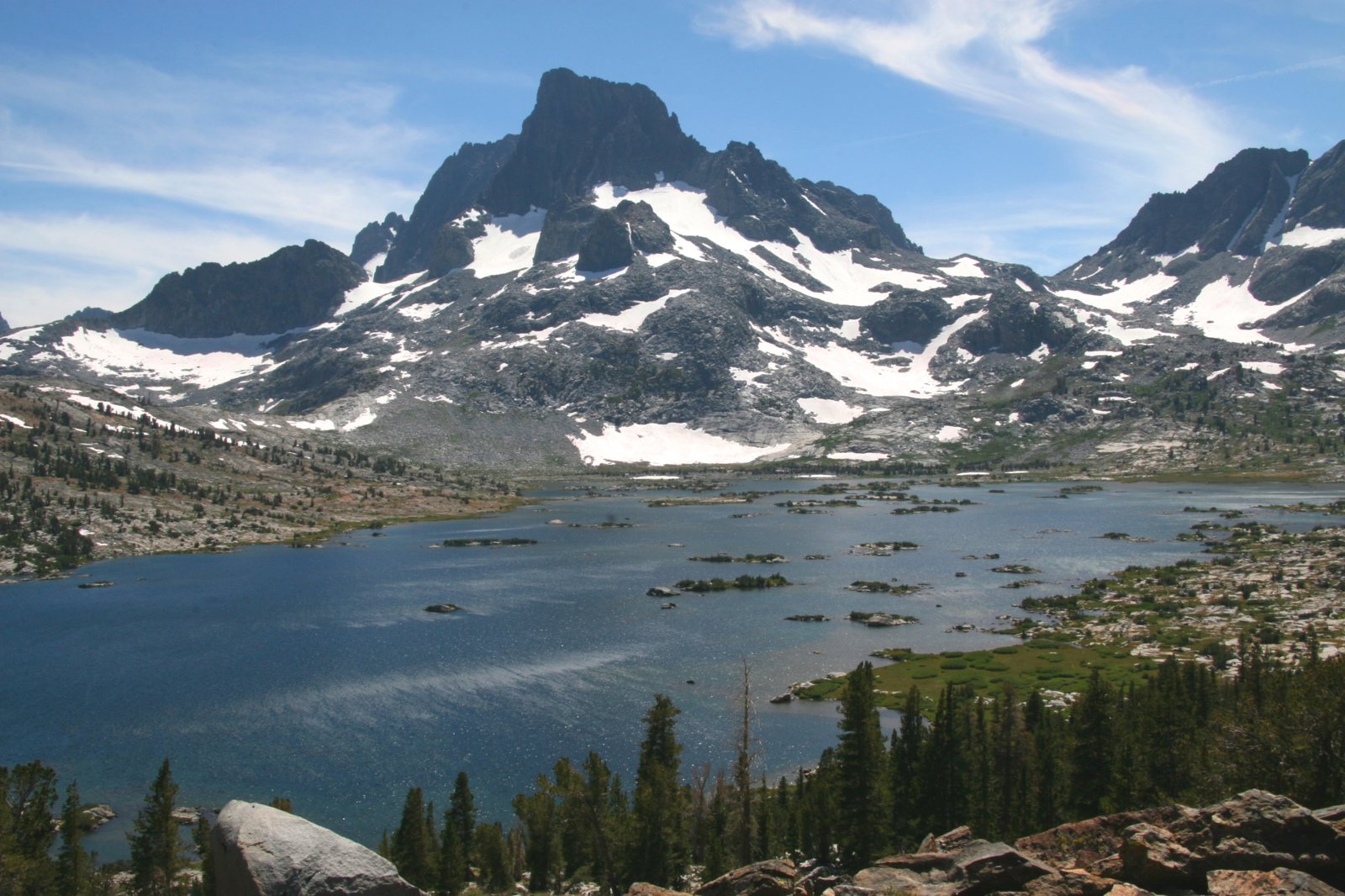
Thousand Island Lake sits at the foot of Banner Peak in the Ansel Adams Wilderness, a big alpine lake dotted with small islands. It lies on both the John Muir Trail and the Pacific Crest Trail. From Agnew Meadows near Mammoth Lakes, the River Trail follows the Middle Fork of the San Joaquin River up to the lake in about 8 miles.
Permits are limited by daily quota, bear canisters are required, and camping is restricted near the lake’s outlet.
The hike
The trip starts at Agnew Meadows, at about 8,300 feet according to Explor Off. Hike Speak says that from the Agnew Meadows shuttle stop it’s about a quarter mile down a gravel road to the High Trail trailhead, and another 0.15 mile to the end of the road where the River Trail begins. Hiking Project notes that if you arrive before 7 a.m., you can drive to the trailhead; after that, you must take the shuttle bus. Hike Speak says the trailheads have small parking areas, toilets, and bear-proof storage lockers.
Two trails lead to the lake. The High Trail, part of the Pacific Crest Trail, traverses high on the canyon wall. Hiking Project describes a fairly stiff climb from 8,300 to 9,700 feet and says few 8-mile hikes into the High Sierra are easier. The River Trail stays lower, along the river, and Hiking Project says you can return that way on a route that’s almost entirely downhill. The two make a loop.
Along the River Trail, Hike Speak notes the junction with the Shadow Creek Trail toward Ediza Lake. Hiking Project’s loop description follows the Pacific Crest Trail north for about 8.5 miles to Thousand Island Lake, then returns south on the John Muir Trail past Emerald and Ruby Lakes to Garnet Lake in 2.5 miles, and on to Shadow Lake before descending Shadow Creek back to the River Trail. It puts the whole loop at about 20 miles.
At the lake, the view of Banner Peak is the main event. Modern Hiker says camping isn’t allowed within a quarter mile of the outlet, and suggests making sure you’re past the lake’s first island before scouting for a tent site. Hike Speak says the north shore is the only area along Thousand Island Lake where camping is allowed.
The Inyo National Forest lists several camping restrictions in this part of the Ansel Adams Wilderness. There’s no camping within a quarter mile of the outlets of Thousand Island and Garnet Lakes, no camping at Shadow Lake or between Shadow Creek and the trail, and no camping within an eighth of a mile of the south side of Ediza Lake. It also lists a campfire restriction area covering Rush Creek, Thousand Island Lake, and Garnet Lake. Several sources say campfires aren’t allowed at Thousand Island Lake or above 10,000 feet.
Hiking Project warns that campsites along the River Trail can be crowded, since anglers often have gear brought in by pack trains. Paria Outdoor Products suggests a three-day loop: Agnew Meadows to Ediza Lake, Ediza to Thousand Island Lake, and back to Agnew Meadows.
For another quota-managed Sierra trip, see the Rae Lakes Loop.
Tips
- Reserve a River Trail permit. Hiking Project lists a quota of 30 per day, 18 reservable and 12 walk-in.
- Plan around the shuttle. Arrive before 7 a.m. to drive in, or take the Reds Meadow shuttle.
- Bring a bear canister. Sources agree they’re required for overnight trips.
- Camp away from the outlet. The Forest Service bans camping within a quarter mile of it.
- Skip the campfire. Fires aren’t allowed at the lake.
Camping
A wilderness permit is required for overnight trips, with a daily quota at each trailhead. The Inyo National Forest says your permit doesn’t reserve or assign a specific campsite, and limits groups to 15 people. It requires bear containers wherever trees aren’t adequate to hang food, and sources say canisters are required on this trip. Respect the posted camping closures at Thousand Island, Garnet, Shadow, and Ediza Lakes.
Inside Intel: Get past the first island before you start looking, Modern Hiker advises, to stay clear of the outlet closure. Hike Speak says the north shore is where camping is allowed, and a commenter there advises paying close attention to signs at Ediza, Garnet, and Thousand Island Lakes. If you’re doing the loop, Paria Outdoor Products’ itinerary camps at Ediza Lake the first night.
Trail facts
- Distance: About 16 miles round trip via the River Trail; about 20 miles as a loop with the JMT and Shadow Creek
- Route type: Out and back, or loop
- Difficulty: Moderate to strenuous
- Elevation: Agnew Meadows about 8,300 feet; High Trail climbs to about 9,700 feet (Hiking Project)
- Campsites: Wilderness camping, with closures near outlets and at Shadow Lake
- Water: River and lakes. Treat all water.
- Permits: Required, with daily trailhead quotas (Recreation.gov)
- Bear and food storage: Bear canister required
- Fires: Not allowed at Thousand Island Lake
- Group size: 15 maximum (Inyo National Forest)
- Trailhead: Agnew Meadows (River Trail or High Trail), via the Reds Meadow road near Mammoth Lakes
- Last verified: October 2, 2026
Where this comes from
This page draws on the sources below, along with other guides and trip reports. Links go to the original pages.
- U.S. Forest Service: Inyo National Forest Wilderness Regulations
- Hike Speak: Thousand Island Lake
- Hike Speak: Ediza Lake-Thousand Island Lake Loop
- Hiking Project: Agnew Meadows to Thousand Island Lake
- Hiking Project: Thousand Island Lake Loop
- Modern Hiker: Thousand Island Lake
- Paria Outdoor Products: Hike of the Week, Thousand Island Lake Loop
Before you go: This page is based on published trail guides, trip reports, and reviews, along with official park and agency information where we could find it. It’s meant to help backpackers discover new trails, not to replace current, official information. Conditions, closures, permits, campsites, and water sources change, and some details here may be out of date or wrong. Confirm everything with the managing agency and check current conditions before you head out, and don’t rely on this page alone for safety or navigation. Backcountry travel involves risk.