
Trails / Connecticut / Eastern Connecticut
Natchaug and Nipmuck Trails (Goodwin State Forest to Bigelow Hollow)
Goodwin, Natchaug, and Nipmuck State Forests and Yale-Myers Forest (Hampton to Union, northeastern Connecticut)
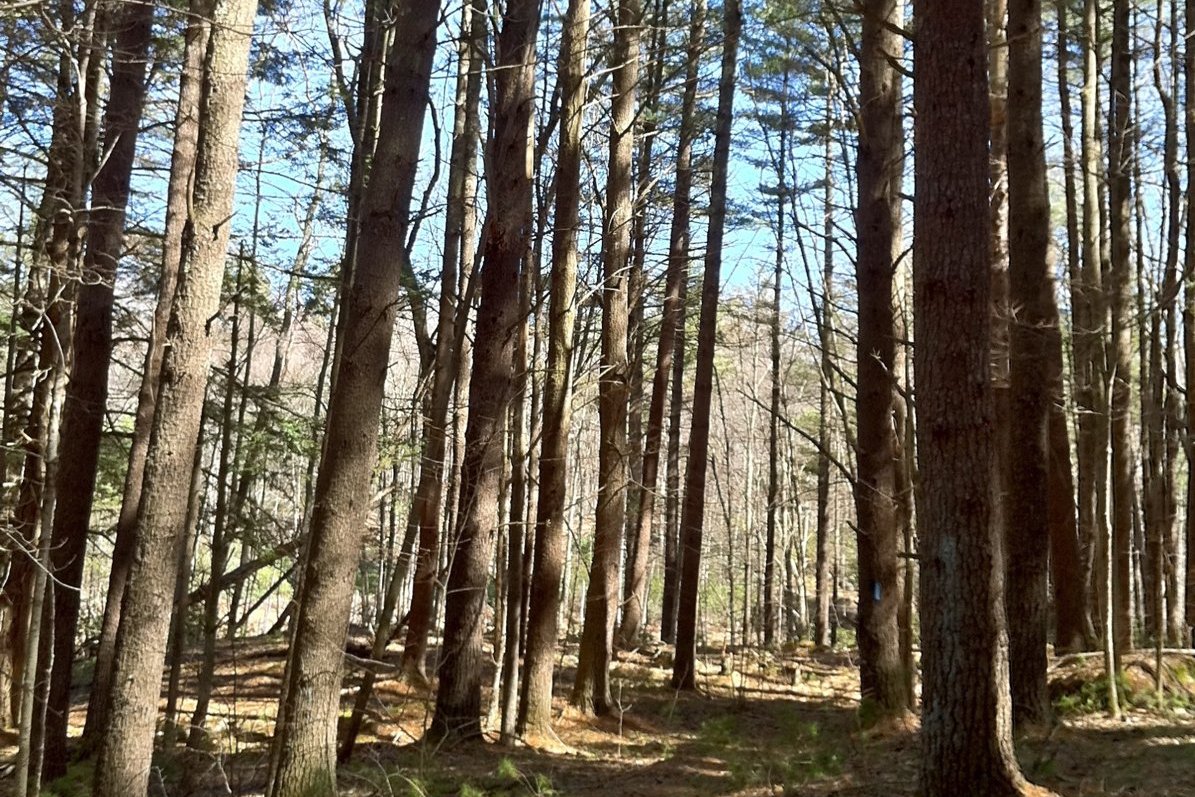
The Natchaug and Nipmuck Trails link into a backpacking trip of about 32 miles through state forests and a Yale University research forest, from Goodwin State Forest in Hampton to Breakneck Pond on the Massachusetts line. Backpacking Routes describes woods still bearing stone walls and cellar holes from colonial days, and says the route can be hiked in two to four days by backpackers of all levels.
Camping is only at a few designated sites, each by permit and for one night.
The hike
Backpacking Routes starts at Goodwin State Forest and follows the Natchaug Trail north. Wikipedia says the Natchaug Trail is 19.5 miles long and passes through Goodwin and Natchaug State Forests and the small Nathaniel Lyon Memorial State Park. AllTrails says it crosses several brooks, passes many ponds, and explores rolling forest. It calls the Natchaug Trail a hard 17.6-mile point-to-point hike with about 1,771 feet of gain.
The first night is at the General Lyon Shelter. Backpacking Routes says you pass through Nathaniel Lyon Memorial State Park, the birthplace of Nathaniel Lyon, the first Union general killed in the Civil War. Wikipedia notes that only a very large fireplace remains of the birthplace. Backpacking Routes puts the shelter a few hundred feet past the chimney, with water from a small stream just before it, about 7.5 miles from Goodwin. An AllTrails reviewer found backpacking permits easy to get and the General Lyon shelter well maintained.
North of the shelter, the Natchaug Trail meets the Nipmuck Trail. Wikipedia says the junction is about 1,200 feet south of Eastford Road in Ashford, in northern Natchaug State Forest, and that a side trail from the Nipmuck leads to Pixie Falls. Backpacking Routes lists a primitive Nipmuck Trail tent site about three-quarters of a mile south of the junction, about 12 miles from the General Lyon Shelter.
The Nipmuck Trail then heads north through the Yale-Myers Forest. Wikipedia says it crosses about 9 miles of the forest, which Yale University owns. The Air Land and Sea calls the Yale Forest section spectacular, and says the Nipmuck is one of its favorite blue-blazed trails. An AllTrails reviewer says the Natchaug is moderate to easy while the Nipmuck is hillier.
For shorter trips, AllTrails lists a 7.8-mile out-and-back from Route 44 south to Nathaniel Lyon Memorial State Park and its old chimney, and reminds hikers that camping is only allowed in designated areas in Natchaug State Forest. The Air Land and Sea points to a nearly perfect 5-mile loop in the southern Yale Forest, including a road section, as a way to avoid crowds.
The trip ends at Bigelow Hollow State Park. Backpacking Routes describes the final day continuing north to Breakneck Pond, where the Breakneck South and East shelters offer one more night, and then to the Massachusetts border before returning to the hiker parking lot. It describes a four-day version that ends with a short, roughly 5-mile final day around the pond.
Connecticut Trail Finder says Natchaug State Forest is popular for its horse trails, fishing, and riverfront picnic sites, and that pets are permitted on leash on its trails. Wikipedia notes that camping facilities are available there for backpackers and equestrians.
For the Breakneck Pond end of this trip, see Breakneck Pond.
Tips
- Apply for every site at least 14 days ahead. DEEP requires written applications.
- Plan one night per site. DEEP limits stays to one night.
- Fill up before the General Lyon Shelter. Backpacking Routes points to a small stream just before it.
- Arrange a shuttle. This is a long point-to-point route.
- Watch for overgrowth. An AllTrails reviewer found a couple of overgrown spots on the northern Natchaug.
Camping
CT DEEP says backpack camping on these trails is only at designated sites, by application at least 14 days ahead, with a one-night limit per site and no pets at the sites. Backpacking Routes lists the General Lyon Shelter on the Natchaug Trail, a primitive tent site on the Nipmuck Trail south of the Natchaug junction, and the Breakneck Pond shelters and tent site. Natchaug State Forest also has horse-packing sites, it notes.
Inside Intel: Backpacking Routes’ three-day plan spaces the nights evenly: about 7.5 miles to the General Lyon Shelter, about 12 more to the Nipmuck tent site, then about 13 to Bigelow Hollow. An AllTrails reviewer suggests the campsite near the Natchaug-Nipmuck intersection as a natural break for a two-day trip.
Trail facts
- Distance: About 32 miles (Backpacking Routes)
- Route type: Point to point, 2 to 4 days
- Difficulty: Moderate to strenuous; the Nipmuck is hillier than the Natchaug
- Campsites: General Lyon Shelter; Nipmuck Trail tent site; Breakneck Pond shelters and tent site
- Water: Streams and ponds. Treat all water.
- Permits: Required for each site; apply at least 14 days ahead
- Pets: Not allowed at backpack sites
- Trailheads: Goodwin State Forest (Hampton); Bigelow Hollow State Park (Union)
- Last verified: October 2, 2026
Where this comes from
This page draws on the sources below, along with other guides and trip reports. Links go to the original pages.
- CT DEEP: Backpack Camping
- Backpacking Routes: Natchaug / Nipmuck Trails
- Wikipedia: Natchaug Trail
- Wikipedia: Nipmuck Trail
- AllTrails: Natchaug Trail
- AllTrails: Natchaug and Nipmuck Trail
- The Air Land and Sea: Nipmuck Trail Guide
- Connecticut Trail Finder: Natchaug State Forest
Before you go: This page is based on published trail guides, trip reports, and reviews, along with official park and agency information where we could find it. It’s meant to help backpackers discover new trails, not to replace current, official information. Conditions, closures, permits, campsites, and water sources change, and some details here may be out of date or wrong. Confirm everything with the managing agency and check current conditions before you head out, and don’t rely on this page alone for safety or navigation. Backcountry travel involves risk.