
Five Tips to Make Water Crossings Suck Less (The Fifth One Could Save Your Life)
This post contains affiliate links. If you buy through them, we may earn a commission at no extra cost to you. As an Amazon Associate we earn from qualifying purchases.
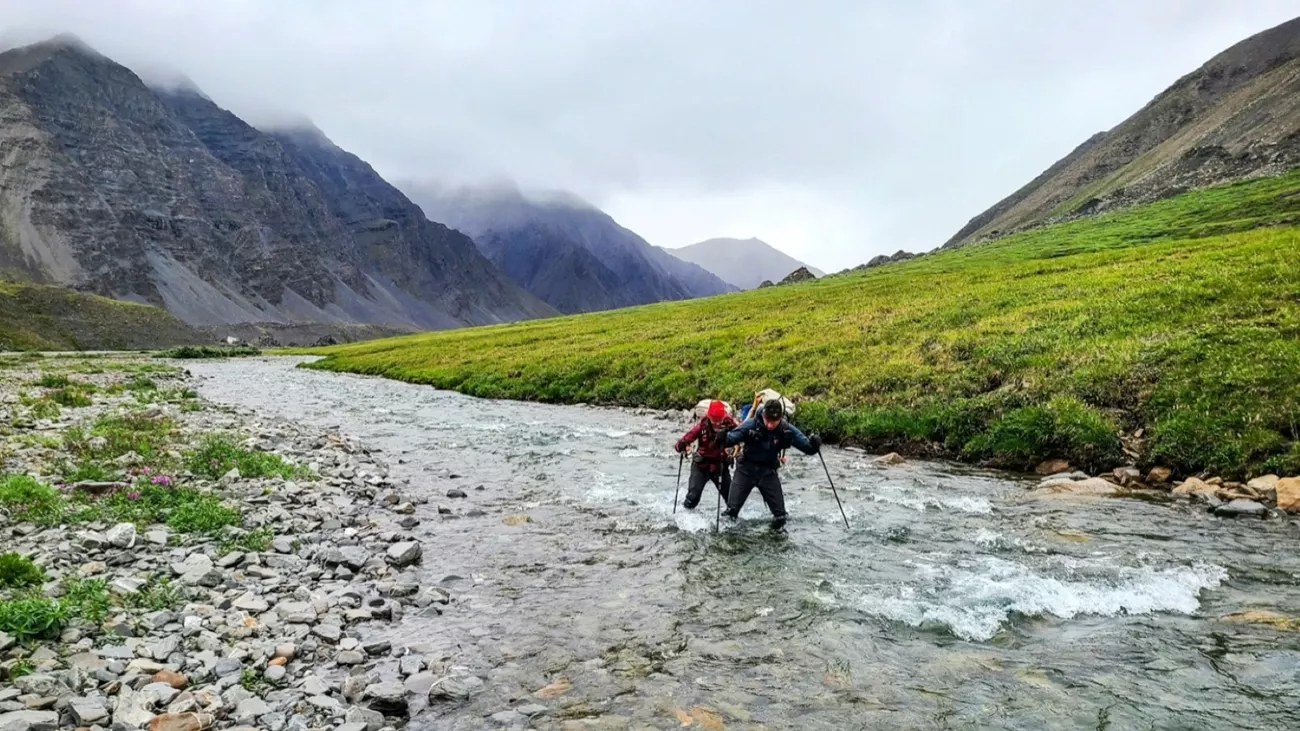
Sooner or later, the trail runs straight into a creek with no bridge. Sometimes it’s an ankle-deep splash; sometimes it’s cold, fast, and loud. A little planning makes the easy ones less of a chore and helps you spot the ones you should skip.
The tips below are compiled from the National Park Service, Backpacker, the Appalachian Trail Conservancy (ATC), and the other published sources named throughout. We left out prices because they change. None of these tips makes a dangerous crossing safe. The NPS puts it bluntly: “If a crossing seems too risky…it probably is!” When in doubt, wait for the water to drop, find another spot, or turn back.
1. Don’t assume the trail crosses at the best spot
“Do NOT assume that the trails cross at the best spot,” writes Andrew Skurka, who notes that many trails were built for summer, after peak flows. SectionHiker makes the same point: if the marked crossing looks risky, you can move upstream or downstream to find shallower, slower water.
What to look for:
- Wide and braided. Backpacker says to ford “at its widest point, where the water will be shallower and slower,” and to look on your map for forks or braids that split the flow. The NPS Alaska page agrees that the widest or most braided part of a channel is usually shallowest.
- Slow, even if deeper. The ATC says to “Cross where the water is moving slowly,” to avoid narrow sections where the current is strongest, and to pick a straight stretch between bends. The NPS notes that the outside of a bend often has a deep cut bank and fast water.
- Nothing nasty downstream. Look at where you’d end up if you slipped. Backpacker and Skurka both warn about rapids, waterfalls, and fallen trees below a crossing, and the ATC says to check for strainers (logs or branches that let water through but can trap a person).
2. Cross early, and let high water drop
On snowmelt-fed streams, timing can matter as much as location. Skurka says to ford potentially dangerous creeks in the morning, when they are relatively low, because “Snowmelt increases as the sun and temperatures rise, and water levels normally peak in early-evening.” The NPS says to “Cross early in the day whenever possible” and to build extra time into your trip so you can wait for lower water.
Rain matters too. The NPS suggests crossing before storms when you can, since rain upstream can raise the water. Backpacker’s Dennis Lewon describes a crossing that became much more dangerous after a night of rain. After storms, the ATC advises waiting until levels drop, and it suggests that solo hikers wait for other hikers before attempting major crossings.
3. Bring a pair of water shoes to change into
A dedicated pair of water shoes lets you keep your boots dry for the rest of the day. “Keep your boots dry by wearing sandals,” says Backpacker’s 2021 river guide, and Lewon adds that sandals or water shoes “improve footing.” What sources agree on is that bare feet are a bad idea: the NPS says “NEVER cross in bare feet,” and SectionHiker points to the sharp rocks, sticks, and thorns on stream bottoms.
One fair counterpoint: for big, hazardous fords, Skurka says to skip river shoes and cross in your hiking shoes or boots, which grip and fit better, and the ATC says to “Keep your shoes on.” Treat water shoes as a comfort upgrade for ordinary crossings, not as a safety device. Here are three that reviewers recommend, each with a catch.
Crocs Classic Clog. CleverHiker likes that they’re light (11.2 ounces per pair by its measure), waterproof, and easy to slip on, and says its pair “dried faster than some of the water shoes we tested.” Treeline Review names them its best overall camp shoe. To keep them on, flip the strap back behind your heel; Treeline notes fans call that “sport mode.” The catch: CleverHiker found their “limited support and poor fit” a problem on more demanding outings, and Treeline says the loose fit is less supportive.
Xero Shoes Z-Trail EV. CleverHiker’s reviewer says they “feel like a second skin,” stay put once adjusted, float, and dry so fast that “they’re great for water crossings.” By CleverHiker’s measure, they weigh 10.8 ounces per pair. Wanda Rice’s 2020 SectionHiker review of the earlier Z-Trail called it “a great sandal for stream crossings or in camp.” The catch: the soles are thin, so you’ll feel rocks, and CleverHiker found traction weak in mud. Its tread wore flat by about 400 miles.
Find the Xero Z-Trail EV: men’s · women’s
Chaco Z/1 Classic. Treeline Review names it the best camp shoe for water, saying “Fording rivers is much easier” in them. CleverHiker’s reviewer praises the sturdy midsole, strong arch support, and grippy lugs. The catch: it’s heavy and bulky, per Treeline. CleverHiker says “Traction is lacking on silty surfaces,” and the firm arch support may not suit low arches.
Find the Chaco Z/1 Classic: men’s · women’s
4. Face upstream, use your poles, and know your limit
Once you’re in, slow and steady wins. The ATC says to “Cross facing upstream, lean into the current, and move one foot at a time.” Backpacker suggests a slight angle in strong current, “heading downstream but facing up,” stepping sideways. Skurka angles downstream too, so he’s fighting less current.
- Three points of contact. Use trekking poles or a sturdy stick to balance and probe ahead. The ATC says poles give you “three or four points of contact.” The NPS suggests holding a staff upstream.
- Shuffle. The NPS says to slide each foot along the bottom rather than stepping high.
- Link up. For a hard crossing, Backpacker says to ford as a group with arms locked, or form a tripod with three people facing in. The NPS puts the strongest, heaviest person upstream. Skurka puts the lightest on the downstream side so the others break the current.
Know when to stop. Backpacker says to look for a safer spot “if the water is fast and knee-deep or more.” The ATC says don’t cross if the water is above thigh height, moving faster than you can walk, or if you can hear rocks rolling along the bottom.
5. Unbuckle your pack straps (this one could save your life)
Before you step into fast water, unclip your hip belt and sternum strap. If you fall, a buckled pack can trap you. Backpacker’s Lewon says to unbuckle both “so you can easily shed your pack if needed,” and the ATC says to unbuckle the hip and chest straps “so you can shed it quickly if you lose your footing and get swept downstream.” SectionHiker warns that a pack can fill with water and drag you under, and that unbuckling lets you “shrug off your pack.” Skurka notes the conventional advice also includes loosening the shoulder straps.
Not everyone treats this as a hard rule. Skurka calls it dated advice from the days of huge packs and argues your pack “should be light enough that you can easily get back to your feet.” If a ford seems to need the precaution, he’d choose a different crossing. The NPS Alaska page notes there is “much debate” about packs, but says to know your buckles so you can shed yours fast. Either way, being able to get free quickly is the point.
If you do go in, here’s what the sources say to do:
- Get on your back, feet downstream. Backpacker and the ATC both say to float this way. The ATC adds to keep your feet up until you reach shallow, calm water, because getting a foot trapped on the bottom is especially dangerous.
- Ditch the pack if it’s dragging you. The ATC: “If your pack is dragging you down or gets caught on something, ditch it.” The NPS suggests keeping basic survival gear in a waterproof bag on your body in case the pack is lost.
- Head for the nearest shore, not the far bank, says the ATC. Then get warm. Lewon says to keep moving, and the ATC suggests considering stopping for the day.